Report — Tool
The Spaghetti Vortex
Ten thousand software agents settled a question about fluids in eighty-eight hours. The question is about what happens inside a cloud. Scroll to watch it.
The Navier–Stokes equations are Newton's second law — force equals mass times acceleration — written for a fluid. Instead of one object, they track a speed and direction at every point in a body of air or water, and how each is changed by pressure and by the fluid's drag on itself. That drag is viscosity: the internal friction that makes honey pour differently from water, and the term that smooths sharp differences away.
Spin in a fluid is not spread evenly. It gathers into tubes — a bathtub drain, a dust devil, the coil of air off a wingtip. Each is a rope of rotating fluid inside fluid that is barely rotating at all.
Let the surrounding flow pull on the rope's ends. It stretches and narrows, and as it narrows it spins faster, for the same reason a skater pulling her arms in turns faster. A thinner rope spinning faster is finer, sharper structure than you began with — and it can be stretched again. This is vortex stretching. In a flat world there is no third direction to stretch along, which is why the two-dimensional problem was settled decades ago and this one was not.
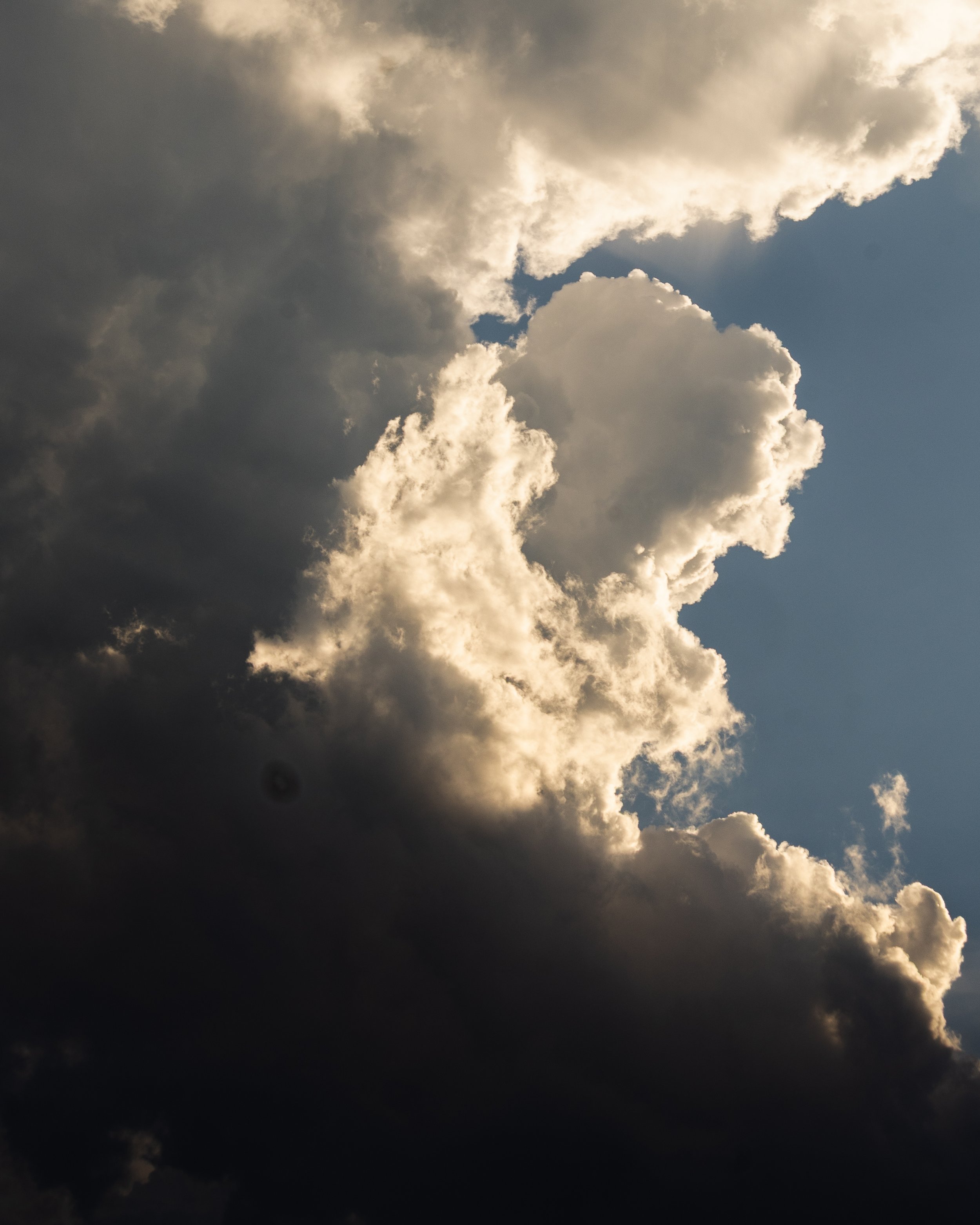
Stretching moves energy from large structures into small ones. Lewis Fry Richardson described it in 1922 as big whirls giving rise to little whirls; Andrey Kolmogorov put numbers on it in 1941. Viscosity waits at the bottom and turns the smallest whirls into heat. A cumulus cloud is this made visible: a cauliflower edge with bulges on its bulges, each scale produced by the one above it.
The open question, on the Clay Mathematics Institute's list since 2000, is whether the cascade can outrun the damping: whether a perfectly smooth start with a finite amount of energy can organize itself so well that some point reaches infinite speed in a finite time. The answer announced this month is yes, under a particular arrangement — a vortex spiralling inward and drawing out longer and thinner, through stages each faster than the last, with infinitely many of them packed into a finite stretch of time.
Two qualifications, both honest. Infinite speed at a single point does not demand infinite energy, because a point has no volume. And air is not a fluid: air is molecules, roughly seventy nanometres apart between collisions, and the equations are an average over enormous numbers of them. Long before the mathematics reaches infinity, the average stops being true and the smooth picture dissolves into billiards. Nothing in the sky has been shown to blow up. Our best description of the sky has been shown to contain a failure mode, reachable from a calm beginning.
A dandelion seed is the same physics running the other way. Put the pappus — the parachute of fine bristles — in a vertical wind tunnel, as a group at Edinburgh did in 2018, and it turns out not to work like a parachute. About a hundred filaments, each sixteen microns thick, leave the structure more than ninety per cent empty, and air passing through that gap forms a ring of recirculating flow that sits detached in the wake, holding position instead of peeling away. Four times the drag per unit of area that a solid disc gives.
Vortex stretching concentrates structure until viscosity erases it or, in the equations, until it runs away. Above a roadside, the same equations hold a piece of structure steady in the air for as long as the seed is falling.
The machines worked on top of human technique: the methods that made the construction possible came from Diego Córdoba and Luis Martínez-Zoroa, and Charles Fefferman, who wrote the problem statement for the Clay Institute, called them the heroes of the story. The proof was checked in Lean, a language in which a proof is a program the computer refuses to run if a step does not follow — which certifies that the argument is valid, not that it is about the thing you think it is about. The Institute has called its own verification deliberately unhurried and has awarded nothing. What the agents supplied was not insight but search at a scale no group of people can staff, and Terence Tao's worry is that a result arriving that way leaves an answer behind it and nothing else. For anyone who wants the lesson rather than the headline, the term to look up is vortex stretching, and the picture to keep is a rope of spinning air being pulled thin.
Sources: OpenAI, Sep 8 2026 · Quanta Magazine · IBM Think (Tao), Sep 10 2026 · Cummins et al., Nature 562:414–418 (2018) · Palmer, Döring & Seregin, Nonlinearity 27 R123 (2014)