Third largest pile
A herbarium is a library of dead plants. Each one was pressed flat, dried, glued to a sheet of
heavy paper, and labeled with where it grew and when it was picked. Some of the sheets are
older than the university that holds them. A large collection runs to hundreds of thousands
of them, filed in steel cabinets, and looks from the outside like an archive of something
nobody will need again.
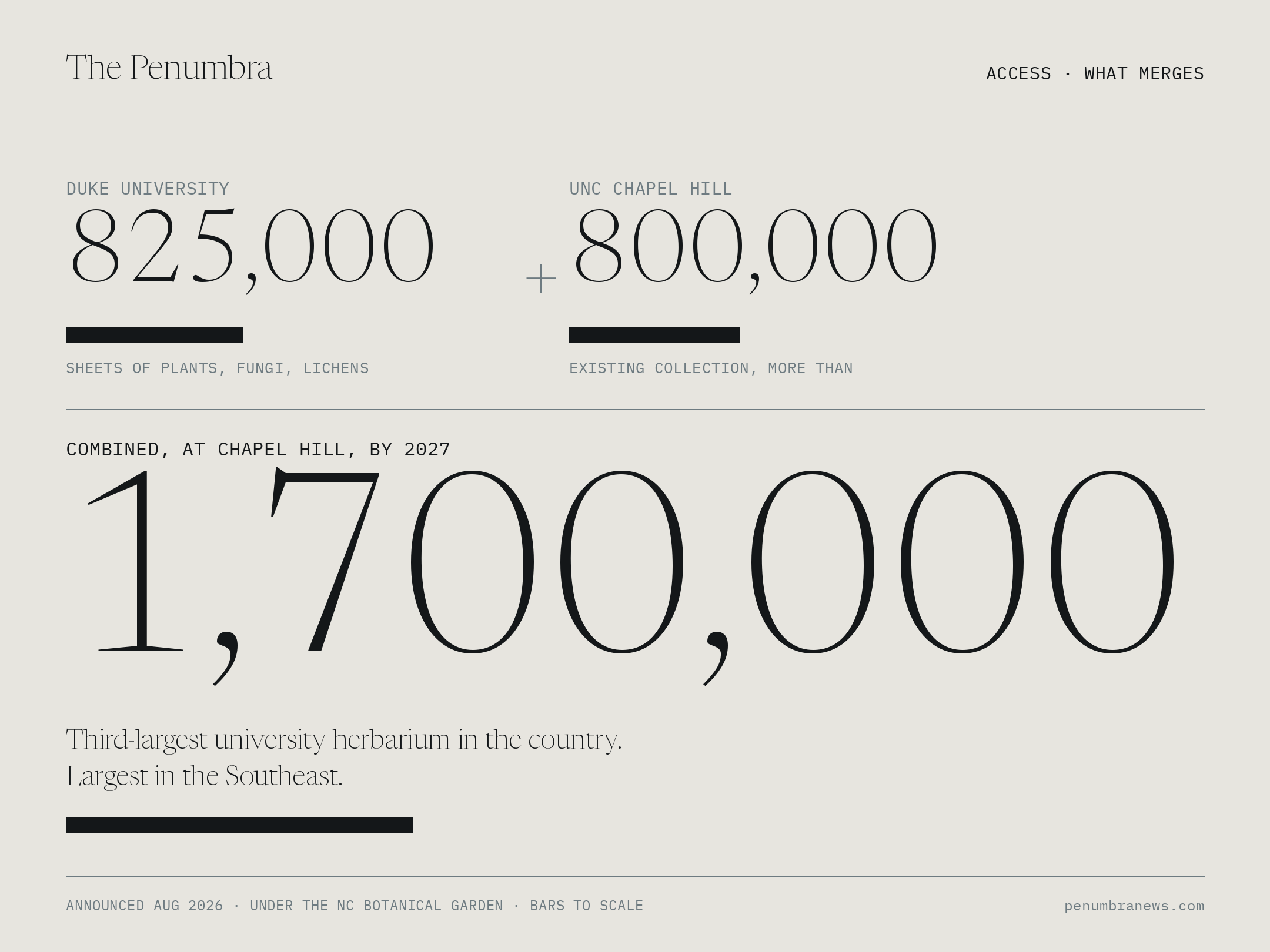
On the last day of August, Duke University and the University of North Carolina at Chapel Hill announced that Duke's herbarium — about 825,000 sheets of plants, fungi, and lichens— will move to Chapel Hill and merge with UNC's collection of more than 800,000, under the North Carolina Botanical Garden, which already runs UNC's. The combined 1.7 million specimens will make it the third-largest university herbarium in the country and the largest in the Southeast.
Duke's sheets will sit in a former child-development center until a building
exists to hold them.
The move closes a story that opened in February 2024, when Duke told the herbarium's
staff it would discontinue investment in the collection and gave them up to three years to
find it a home. The stated reason was money: outdated facilities, and at least twenty-five
million dollars to renovate them and endow the curators and staff a collection of that size
requires. Mohamed Noor, of Duke's biology department, put the constraint plainly at the
time. A herbarium needs faculty hired to study it "consistently and without any lapses," and
a department that commits to that gives up the freedom to hire in other directions.
That is a fair description of what a herbarium is: a set of objects plus the continuous labor of
people who know what the objects are — who file them, re-identify them as names change,
answer the loan requests, and keep the cabinets sealed against beetles. Withdraw the labor
and the sheets remain. The herbarium does not.
Kathleen Pryer, who ran Duke's collection until she retired last year, made this the condition
of the merger's success. UNC has to hire the curators and faculty to match the collection,
she said, or what it has acquired is "the third-largest pile of specimens in the country." The
distinction is the whole story. A sheet you cannot find, or whose label carries a name
nobody has checked since it was collected, has stopped being evidence of anything.So the numbers are worth setting beside each other. Duke declined to spend twenty-five
million dollars to keep its herbarium. The North Carolina Botanical Garden now hopes to
raise a hundred million for a Plant Biodiversity Research Center to house both, and its
director expects to have it within two years. The sheets move in 2027 either way. Whether
they arrive at a herbarium or a pile depends on money not yet raised and positions not yet
posted.
UNC's curatrix, Carol Ann McCormick, has done this before, and recently. She took in North
Carolina A&T's collection after its curator died suddenly, and St. Andrews University's after
that school closed. Three collections in roughly eighteen months, all flowing to the one
place in the state still hiring people to look after them. Collections are not disappearing so
much as concentrating — in fewer buildings, under fewer people, each carrying more.
The field has a term for a collection whose institution stops paying for it: an orphaned
collection. It is worth knowing, because Duke's was not the first this year in North Carolina,
and the merger does not change the arithmetic that produced it.
Disclosure: The Penumbra's editor did cataloging and digitization work for Botanic Gardens
Conservation International.