The Chinese Money Plant Is Doing Geometry
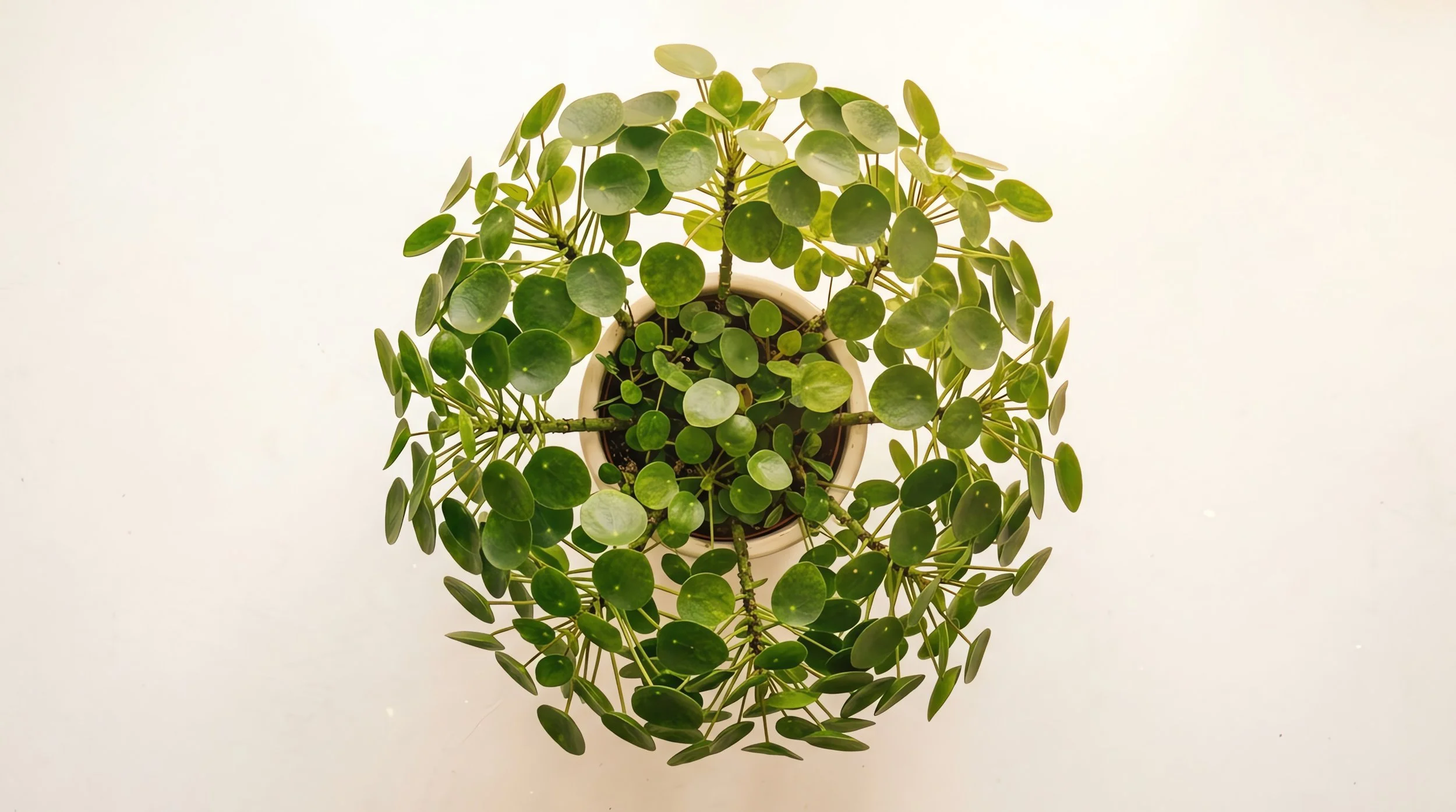
Pilea pepromioides
A common houseplant turns out to divide its own leaf the way a city divides school districts. The interesting part is what it takes to prove that.
Report — Nature Communications, May 12, 2026
Look at the underside of a Pilea peperomioides leaf, the round coin-shaped houseplant that arrives as a gift and then quietly outlives the relationship. The veins loop rather than branch. They close into polygons. Scattered across the blade are small secretory pores called hydathodes, which release water at the leaf's surface — and, it turns out, sit almost exactly at the centers of those polygons.
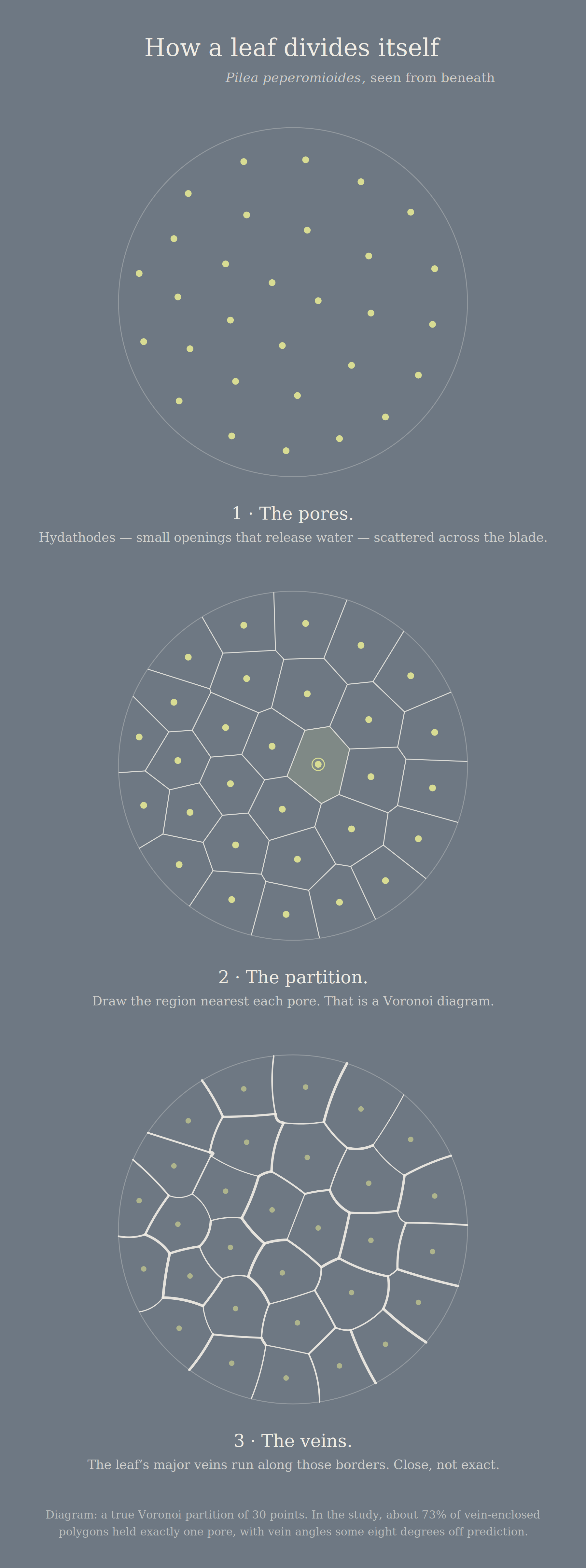
Three diagrams of a round leaf. First, scattered dots marking water-releasing pores. Second, the same dots with lines dividing the leaf into regions, each containing one pore. Third, the same divisions drawn as curved veins.
Researchers at Cold Spring Harbor Laboratory, working with a longtime vein-patterning specialist at the University of Calgary, report that the major veins of this plant form an approximate Voronoi diagram. A Voronoi diagram is a way of carving up space around a set of centers so that every point in a region is nearer to its own center than to any other. It's the math behind school-district lines, cell-tower coverage maps, and the packing of a giraffe's coat.
What makes the Pilea case unusual is that both halves of the diagram are visible at once: the centers are the pores, the edges are the veins. Worth noting that in most natural Voronoi-like patterns, the centers are invisible or absent, and the resemblance stays a resemblance.
The team mapped 34 leaves from six plants. Roughly 73 percent of the vein-enclosed polygons contained exactly one pore. Vein angles ran about eight degrees off the geometric prediction; region overlap came in near 72 percent. Close, not exact — which is the honest shape of the finding, and the reason the word approximate keeps appearing in the paper.
Then the harder question: how would a leaf build such a thing without a plan of it?
The proposed answer runs through auxin, the plant hormone that moves directionally from cell to cell and marks out where veins will form. The dominant model for the last half-century — canalization — has auxin flowing from sources to sinks and carving vein channels along the way, which reliably produces branching trees rather than closed loops. The new model inverts the geometry. Auxin spreads from the pores as neighboring sources, and veins form where their advancing fronts meet, bisecting the space between them. Bisect between every pair of neighbors and loops fall out on their own. The team checked this against the PIN proteins that pump auxin through tissue, and found the pumps concentrated at and around the pores, sparser in secondary veins, and oriented toward veins in the cells alongside them — broadly what the model predicted.
The most persuasive evidence is the least glamorous. Plants were raised under deep shade, harsh light, and heat. The leaves came out smaller, larger, paler, more crinkled — visibly different objects. The Voronoi structure held. That is difficult to reconcile with a fixed blueprint specifying where each vein goes, and easy to reconcile with a local rule that runs wherever the pores happen to land.
It's tempting here to say the plant is doing math, and the temptation is worth pausing on rather than indulging. We are pattern-hungry animals; the whole discipline of a paper like this one is the machinery that separates a pattern we found from a pattern that is there. Seventy-three percent, eight degrees, and the environmental stress test are that machinery. What they support is narrower and stranger than a computing plant: a set of local chemical interactions whose outcome we can describe, after the fact, with a geometry we invented for other reasons. Whether the "after the fact" is doing real work in that sentence, or is just a habit of how we prefer to talk about ourselves, is a question the leaf is not obliged to settle.
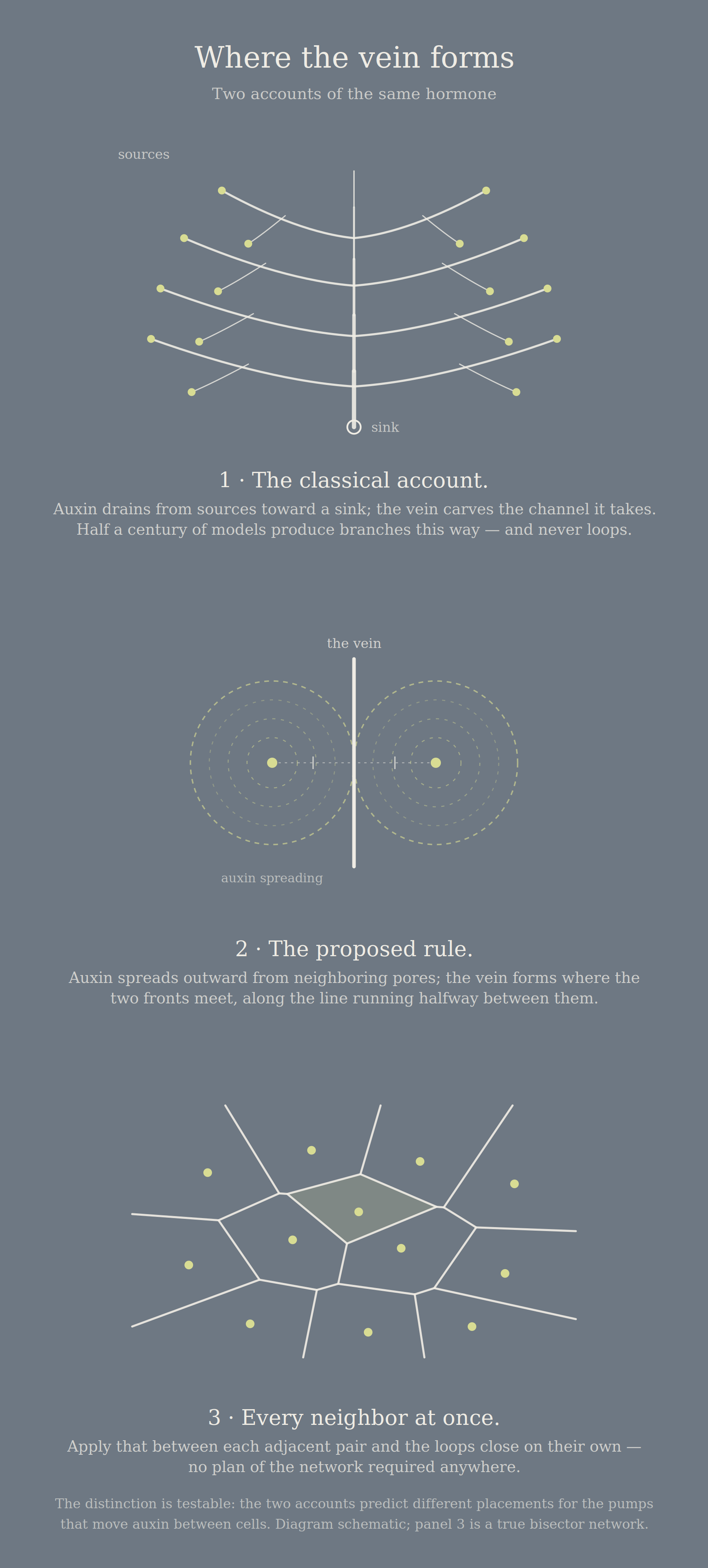
Three diagrams. First, a branching vein pattern flowing from scattered points to a single sink, forming no loops. Second, two points with dashed circles expanding around each, meeting at a vertical line halfway between them. Third, many points with lines running halfway between each pair, closing into cells.
What remains open is scope. Reticulate — looping — venation is characteristic of flowering plants generally, but Pilea is legible because its centers are visible. Whether other species build their loops by the same bisecting rule, with centers we haven't learned to see yet, is now a testable question rather than a speculative one. Prusinkiewicz, who has worked on vein formation for decades, called it a plausible answer to a long-open question. Plausible is the right word, and a lot rides on where it goes next.