What Synergetics Explains, and What It Only Describes
Here is an experiment you can run at your desk in about ten seconds.
Hold both index fingers out and wag them in opposite directions — left finger going left while the right finger goes right. Now speed up. Past a certain rate, without deciding to, both fingers will flip to moving the same way together. Try to force them back and the pattern falls apart.
It works on everyone. Nothing in your nervous system stores a rule that says at this frequency, change modes. The switch belongs to the whole coordinating system and appears only when one measurable quantity — speed — crosses a threshold.
Hermann Haken worked this out with the movement scientists J. A. Scott Kelso and Herbert Bunz in 1985. The HKB model predicted where the transition would happen before anyone measured it, and the measurement matched. That is a real result and it is not in dispute. What is in dispute is everything built on top of it.
The laser, and the two ideas
Haken did not come to this through biology. He came through light, and before that through pure mathematics — his 1951 doctorate was on a problem in group theory, no physics in sight.
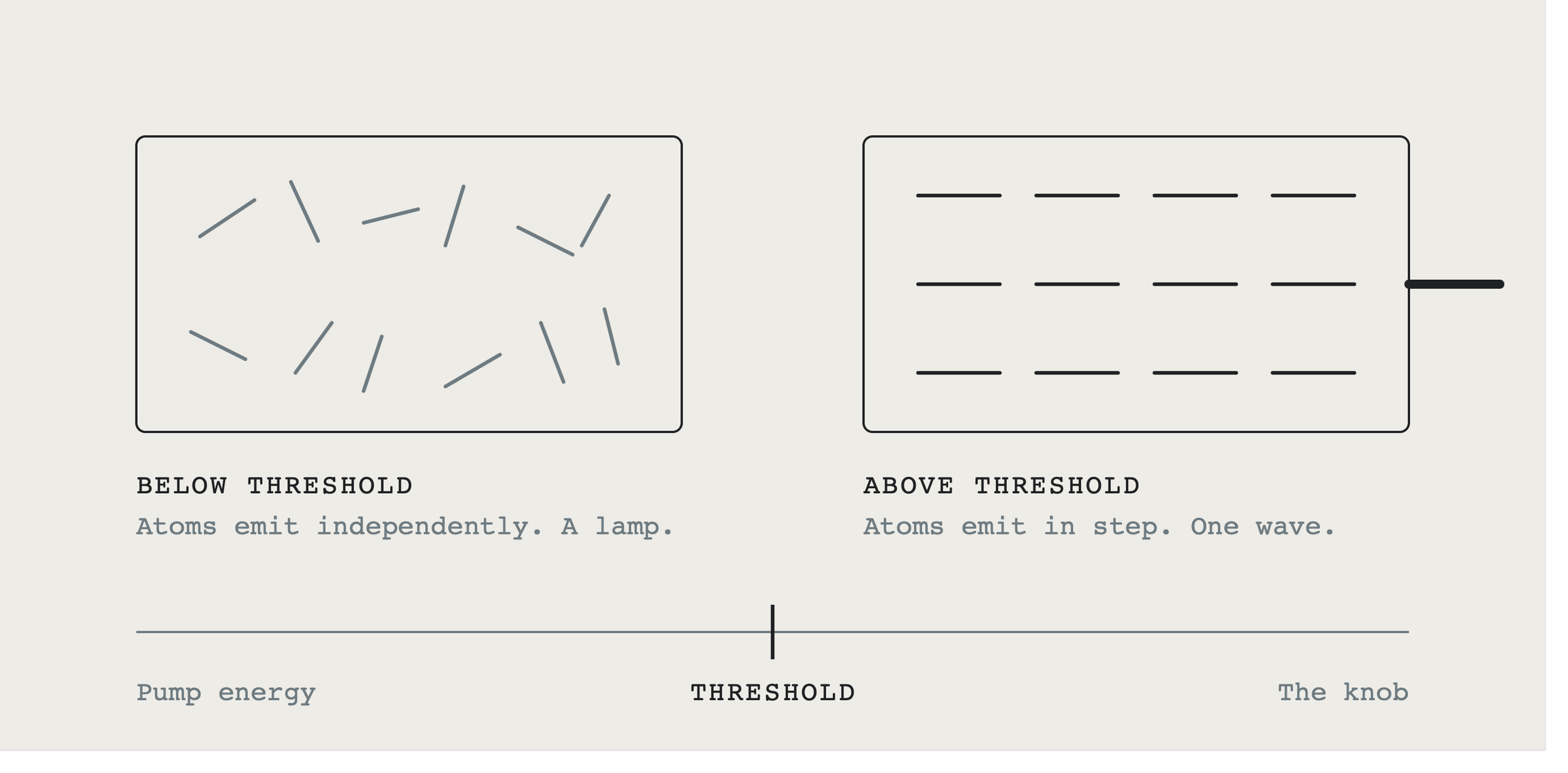
A laser tube has two behaviors. Below a certain pump energy the atoms radiate independently and the device is a lamp. Above it they fall into step and emit one coherent wave. Same tube, same atoms, one knob. In 1970 Haken and his doctoral student Robert Graham showed this transition behaves formally like a phase change — like water freezing — even though a laser sits nowhere near thermal equilibrium.
That is the seed. If a lamp becoming a laser is the same kind of event as a liquid becoming a solid, the same mathematics might describe anything that suddenly organizes itself, whatever it happens to be made of. Haken named the program synergetics and set it out in Synergetics: An Introduction (1977).
Two ideas carry it. The order parameter: near a transition, a system with an absurd number of parts can be described by one or two quantities. A laser has something like 10¹⁵ radiating atoms and one field amplitude that tells you what they are all doing. The slaving principle: once that order parameter exists, the fast components stop acting independently and follow it. Haken's own word for what happens to them is enslaved, and he used it consistently across three decades of textbooks, which tells you something about how thoroughly the top-down direction of causation was meant.
The parts make the order parameter. The order parameter then governs the parts. Haken called that circular causality, and people either find it clarifying or find it suspicious, usually within the same minute.
1977
Two books came out that year. Haken's Synergetics, and Ilya Prigogine's Self-Organization in Nonequilibrium Systems, written with Grégoire Nicolis. Both described order emerging in systems driven far from equilibrium. Both reached for the language of phase transitions and order parameters. They were not the same theory — Prigogine came out of thermodynamics, Haken out of nonlinear dynamics — but they were unmistakably aimed at the same territory.
Prigogine won the Nobel Prize in Chemistry that year, for dissipative structures. Haken got a book series.
I want to be careful here, because the tidy version of this story is a feud, and a feud is not documented. What is documented is that two programs grew up in parallel, that one of them collected the prize and the bestseller, and that Haken spent the following decades building institutional infrastructure instead: the Springer Series in Synergetics, which he edited from volume 1 to volume 84, and a collaborative research center at Stuttgart that pulled architects, town planners, biologists, and engineers into the framework. Evelyn Fox Keller's history of self-organization in Historical Studies in the Natural Sciences (2009) is the sober account of how the field actually assembled itself.
Controlling the venue in which your own paradigm publishes is not misconduct. It is, however, the kind of thing that makes a research program very hard to falsify from the inside.
The paper nobody answered
Philip Anderson won the 1977 Nobel Prize in Physics — the same year, different discipline — and wrote "More Is Different" (Science, 1972), the four-page paper that made emergence intellectually respectable. He argued that each level of complexity has its own laws and does not reduce to the level beneath it. He was not a reductionist looking for a fight.
With Daniel Stein, Anderson then argued that the central analogy of this entire field is empty. In "Broken Symmetry, Emergent Properties, Dissipative Structures, Life: Are They Related?", reprinted in his Basic Notions of Condensed Matter Physics (1984), the two of them pointed out that equilibrium systems which break symmetry acquire something real and durable — rigidity, stability, a structure that holds itself together. Driven far-from-equilibrium systems have never been observed doing that, and Anderson and Stein could find no mathematical reason why they should. They named the laser and the Bénard convection cell specifically, because those were the showpieces. Their conclusion was that there was no developed theory of dissipative structures, and possibly nothing stable for a theory to be about.
That was forty-two years ago. The field did not retract, did not seriously rebut, and did not slow down. It expanded — into medicine, cognition, psychology, and eventually sociology and urban planning, where Haken and Juval Portugali published a synergetic model of city formation in 1995.
There is a quieter technical objection too. The slaving principle is closely related to the center manifold theorem, which dynamical systems theory already had. Haken knew this; he and Arne Wunderlin published on the relationship in 1981 and argued that the slaving principle goes further because it handles fluctuations and constructs the reduction explicitly. That defense is legitimate. Whether what remains is a new science or a well-branded corner of an existing one is a question mathematicians still answer differently, and you should notice that the answer usually correlates with which department the person works in.
The test that actually sorts it
Haken held, following Popper, that a theory can never be verified, only falsified. Apply that to his own program and the line falls in a specific place.
Ask one question of any synergetic model: is the control parameter something you can measure and turn, or something you can only name after the fact?
In a laser you turn the pump. In the finger experiment you set the metronome. Both made risky predictions and both survived them. In a city, nobody can point to the knob, which means the model cannot fail — and a model that cannot fail is producing vocabulary rather than physics. Anderson's challenge sits on the other end and still stands wherever anyone claims a driven system acquires the durable stability of a frozen one.
Haken died on 14 August 2024, at ninety-seven, having published somewhere near six hundred papers. The order parameter is a genuinely powerful instrument and this magazine will keep using it, which is exactly why the knob question gets asked out loud every time rather than assumed. If you want the next layer, read "More Is Different" first — fifteen minutes, and it argues for emergence before it argues against this version of it — then Synergetics: An Introduction. The terms that open the literature are order parameter, control parameter, bifurcation, and center manifold.
Sources and further reading
Haken, H. 1977. Synergetics: An Introduction. Springer.
Haken, H. 1983. Advanced Synergetics. Springer Series in Synergetics 20.
Haken, H., Kelso, J. A. S. & Bunz, H. 1985. "A theoretical model of phase transitions in human hand movements." Biological Cybernetics 51: 347–356.
Kelso, J. A. S. 1995. Dynamic Patterns: The Self-Organization of Brain and Behavior. MIT Press.
Kröger, B. 2015. Hermann Haken: From the Laser to Synergetics. Springer.
Nicolis, G. & Prigogine, I. 1977. Self-Organization in Nonequilibrium Systems. Wiley.
Keller, E. F. 2009. "A History of Self-Organization, Part Two." Historical Studies in the Natural Sciences 39(1).
Anderson, P. W. 1972. "More Is Different." Science 177(4047): 393–396.
Anderson, P. W. & Stein, D. L. "Broken Symmetry, Emergent Properties, Dissipative Structures, Life: Are They Related?" In Anderson, Basic Notions of Condensed Matter Physics (1984), 263–285.
Wunderlin, A. & Haken, H. 1981. Zeitschrift für Physik B 44: 135.
Haken, H. & Portugali, J. 1995. "A synergetic approach to the self-organization of cities and settlements." Environment and Planning B 22: 35–46.